
Volume 25, Week 8
Full share & 🐥 yellow🐥 half shares
218 Gates Avenue between Classon and Franklin
(IMPACCT Brooklyn at the Gibbs Mansion)
5:00 to 7:30 pm
It’s our 25th season!
2026 is our 25th year serving our community with vegetables and more from Windflower Farm. Throughout this season, we'll share announcements here of special events and ways for you to get involved.
Calling all young artists!
We are seeking original illustrations of CSA fruits and vegetables from CSA members age 0-12 to post during distribution as we celebrate our 25th season! Send submissions to information@clintonhillcsa with the subject line "artwork" - a high quality photo or scan is fine. Be sure to include the name of the fruit or vegetable (this can be part of the illustration), and the artist. A list of common share contents can be found here. We'll accept submissions on a rolling basis, and will continue to post them throughout the season!
This week’s share
Misc. Lettuce
Radicchio
Swiss chard
Tomatoes
Parsley
Cucumbers
Crème Brulee shallots
Happy Rich broccolini or summer squash
Yellow wax beans
Fruit: Blueberries from Windflower and Yonder Farm
Extras: Bread, eggs,
News from Windflower Farm
Delivery #8, July 23, 2026
I am sure that you have heard by now about the Cyclospora outbreak that has sickened thousands of people who have consumed leafy greens in recent weeks. This case appears to involve human fecal contamination in shredded iceberg lettuce grown in Mexico, processed in California and distributed in more than a dozen states. But uncertainty remains high, and cilantro is also under suspicion.
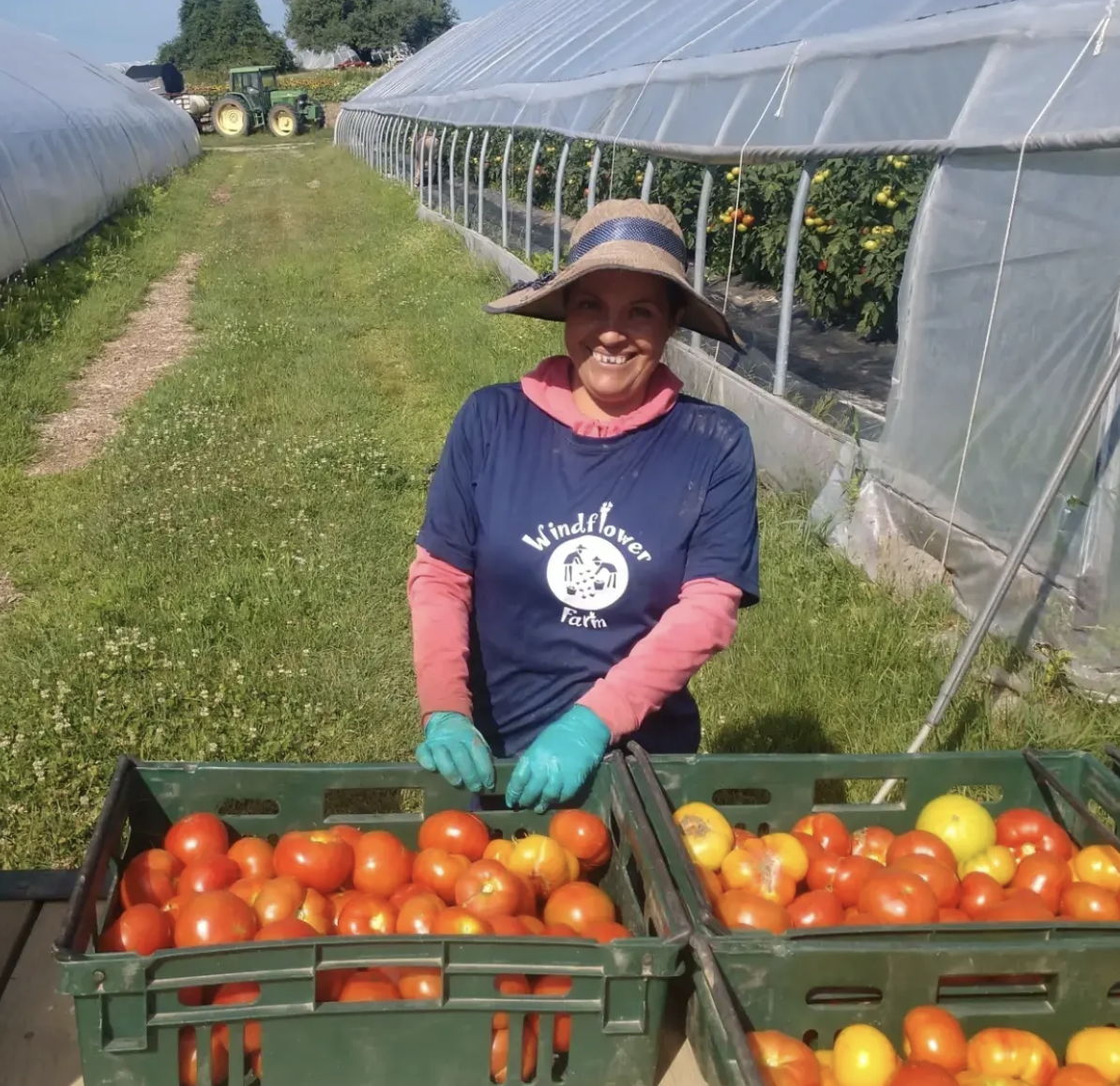
At Windflower Farm, we take food safety very seriously. I thought you might wonder what we do to keep the produce we send to you free from contamination. Most importantly, we follow USDA protocol for produce handling (I have written before about FSMA - the Food Safety Modernization Act) and are inspected annually for compliance by NYS Ag & Markets. Here are some specifics.
1. We have worked hard to eliminate the risk that fecal matter might infect our irrigation water. We have installed an 8’ fence around the farm. There are no deer or cattle or other livestock in or around our fields or water sources. (Nate has three Icelandic sheep that live on pasture well away from our vegetable fields.) Most of our irrigation and wash water comes from a well that is over 400’ deep. Our toilet facilities are far away from water sources.
2. We comply with two important rules regarding Irrigation water: we use sprinklers only when applying deep well water that has tested negative for coliform bacteria. When we use pond water, we only employ drip irrigation so that crop leaves and fruits do not contact the water.
3. We have trained our staff in the importance of hand washing prior to every harvest and always after using the facilities. We provide our employees with ready access to bathroom facilities that are well-stocked with hand-washing supplies (soap, clean water, and hand towels).
4. We harvest using sterilized knives into sterilized harvest crates. Once a crate has left the field, it never touches the ground (or floor). Our containers are always palletized. And we ship using deeply cleaned and sterilized shipping containers. Our wash water is tested frequently for coliform bacteria, and, per FSMA guidance, we use a sanitizer in our dunk tanks.
5. We use an audited system as part of our organic certification for tracing from shipping containers to harvest dates and fields and even to seed lots. If ever a crop of ours was suspected of making someone sick, we or some authority could trace the item back to a shipping date and to all the locations that item was delivered to. We would know after just a few calls if others in the CSA were also sickened by this item and we could take prompt action.
Regarding the current outbreak, this captures the problem: “In a global food system, where a lot of fresh produce is shipped across the world, inadequate hand-washing facilities or a leaky latrine on a single farm could sicken many people even thousands of miles away.” (Alice Callahan and Caroline Hopkins Legaspi, New York Times, 7/21/26).
Taylor Farm, the suspected source of the outbreak, is said to produce some 40% of salad greens sold in the US. Its outlets include grocery stores that sell bagged lettuce and restaurant chains that incorporate greens and cilantro in their menus. Among the problems of large-scale production is that the scale of any outbreak is also potentially large. Small, local farms are not perfect but, by definition, they can only cause a small number of people to become ill, and they are usually just a phone call away.
We value health and safety in the production of nourishing organic produce for our families, staff and CSA members.
Best wishes, Ted
Recipes
Martha Stewart’s files on radicchio and wax beans, plus a very green frittata for your Swiss chard :)
Did you know? Our website has recipes, food storage tips, and information about the vegetables you might come across in your share!